Animals Around Agadir: Four Kinds of Trip, and One That Deserves a Warning
Updated September 24, 2026 · 7 min read
Animal trips from Agadir cover four genuinely different things. Three are straightforward. One needs a paragraph before you book it, and it is the one on every postcard.
Crocoparc: better than it sounds
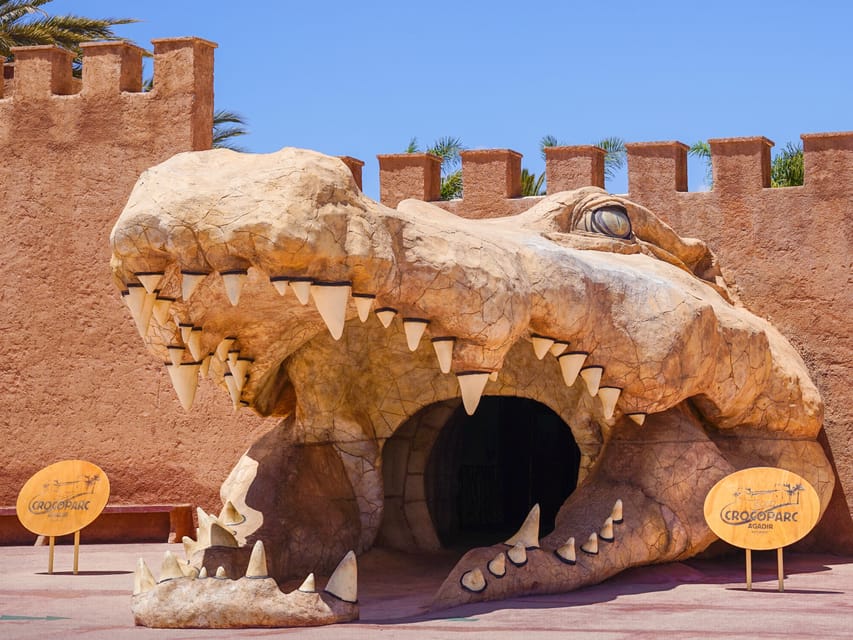
The name suggests a roadside attraction. It is a landscaped park at Drarga, on the N8 at kilometre 16 inland from Agadir, and it holds over 300 Nile crocodiles alongside iguanas, pythons, anacondas and sulcata tortoises. The crocodiles live in heated aquatic enclosures set into botanical gardens — five themed gardens, one of them a cactus garden.
It is, in practice, half zoo and half botanical garden, and the gardens are the part visitors underrate. Feeding times are the thing to ask about at the gate; they are when the animals stop looking like ornaments.
Two ways to buy it:
- The entry ticket alone, from €10. Skip-the-line, valid 30 days, free cancellation up to 24 hours before. You arrange your own transport — it is a short taxi ride, and agreeing the return trip before you set off saves an argument later.
- The package at €23, with return hotel transfers by minibus, a guided tour in Arabic, English, French or German, and tea with pastries.
The gap between the two is the transfer and the guide. If you have a car or are relaxed about taxis, the ticket is the better deal. If you are without either and travelling with children, the package removes the part of the day that goes wrong.
The operator lists the site as wheelchair accessible. As with every accessibility claim, confirm it with them directly for your own case before you commit — the listing describes the venue, not your route through it.
Souss-Massa: the serious one
South of the city, the Souss-Massa National Park runs down the Atlantic coast from the estuary of the Oued Souss towards Sidi Ifni. It was created in 1991 and covers 33,800 hectares — 338 km².
Its reputation rests on one bird. After an unexplained die-off in 1996 the northern bald ibis was down to 59 breeding pairs in the wild worldwide. The park holds three of the four Moroccan colonies, and together with the nearby site at Tamri they account for the overwhelming majority of the world’s genuinely wild breeding birds. The population has recovered into the hundreds since, and the count moves every season, so treat any specific number you read — including in a tour description — as a snapshot.
The park also runs a reintroduction programme for desert ungulates: scimitar oryx, addax, dama gazelle and dorcas gazelle, with North African ostrich under way. These are in enclosures; this is a recovery project you are looking at, not a safari.
There is a nature trail at the Oued Souss and a visitor centre at the Oued Massa. Our stock holds 20 park trips, from €10, median €21.76, and they cluster in the early morning, which is correct — the birds, and the light, are both better before the wind gets up.
This is also the excursion that argues hardest for your own car. The distances inside the park are real, public transport towards Massa and Sidi R’bat is thin, and the best hours are the ones no minibus is running. If you want to be at the estuary at sunrise, comparing rental cars for Agadir is a more useful exercise than comparing tours. The full range of guided options is on the Souss-Massa National Park page.
Camels: two hours, and what they actually are
Camel rides here are not desert expeditions. The most-reviewed camel-only trip is a two-hour outing at €17.66 — hotel pickup, air-conditioned transport, and a ride from a ranch out through eucalyptus forest and along the Souss river, near the royal palace. Mint tea at the end.
That is a pleasant hour on an animal in a river valley, and if you book it expecting the Sahara you will be disappointed by geography rather than by the operator. The camel rides category holds 27 offers, from €10.40, with a median of €20 — sunset versions and combinations with quad biking sit at the upper end.
Photographs at the ranch are usually charged separately, in dirham, and are not part of the price.
The goats in the argan trees
This one needs the honest version.
Goats do climb argan trees. It is real behaviour: the trees fruit, the goats want the fruit, and in dry seasons when there is nothing worth eating at ground level they go up. Nobody invented that.
What you see from the roadside north of Agadir is usually something else. Since the early 2000s, herders have placed goats in trees for tourist photographs and tips. National Geographic documented how it works: goats coaxed up with argan fruit and grain and prodded into position with a stick, or in one herder’s description, picked up and put back until they stop resisting. They stand, in one account, from late morning to mid-afternoon — the hours when traffic is heaviest.
The objections are on the record and are not from campaigners alone. A Moroccan veterinarian quoted in the same reporting warns that hours in a tree through a Moroccan summer can lead to heat stress and dehydration. An animal welfare advocate puts it more bluntly: it may look benign, and it is cruelty.
So: the argan trees and goats category exists in our stock — 13 offers, from €10.20 — because the co-operative visits attached to these trips are genuinely worth doing. Argan oil pressed by hand, by women’s co-operatives, is one of the few crafts in the region you can watch from raw nut to bottle.
Our suggestion is narrow and practical: book the co-operative, not the photograph. If the stop is a tree with goats in it beside a busy road and a man collecting tips, you already know what you are looking at. If a goat is in a tree because it walked there, that is a fine thing to see — and it will be in a grove, not on the hard shoulder.
The rest of what runs from Agadir is on the things to do in Agadir page.